
Organometallic Compounds



Medchemexpress LLC Tos-PEG3-CH2COOtBu | 1530778-24-5 | Pure form | 418.50 | 100 MG

Tos-PEG3-CH2COOtBu is a PEG-based PROTAC linker designed for use in the synthesis of PROTACs. PROTACs are molecules that leverage the body's natural ubiquitin-proteasome system to selectively degrade target proteins by linking a target protein ligand to an E3 ubiquitin ligase ligand.
- PEG-based PROTAC linker
- Used in the synthesis of PROTACs
- Contains two different ligands connected by a linker
- Exploits the intracellular ubiquitin-proteasome system
- Designed to selectively degrade target proteins


eMolecules 83622-41-7 | 2-(Dichloromethyl)-4,4,5,5-tetramethyl-1,3,2-dioxaborolane | Ambeed | MFCD27976342 | 210.890 | C7H13BCl2O2 | 97.000 | CC1(C)OB(OC1(C)C)C(Cl)Cl | 10g | 811906862
2-(Dichloromethyl)-4,4,5,5-tetramethyl-1,3,2-dioxaborolane | Ambeed | 83622-41-7 | MFCD27976342 | 210.890 | C7H13BCl2O2 | 97.000 | CC1(C)OB(OC1(C)C)C(Cl)Cl | 10g | 811906862
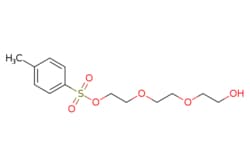
eMolecules 77544-68-4 | Tos-PEG3 | Medchem Express | MFCD18433414 | 304.360 | C13H20O6S | 98.000 | Cc1ccc(cc1)S(=O)(=O)OCCOCCOCCO | 250mg | 746319413
Tos-PEG3 | Medchem Express | 77544-68-4 | MFCD18433414 | 304.360 | C13H20O6S | 98.000 | Cc1ccc(cc1)S(=O)(=O)OCCOCCOCCO | 250mg | 746319413

eMolecules 42152-44-3 | Copper(I) trifluoromethanesulfonate | Oakwood Chemical | MFCD18071026 | 212.610 | CCuF3O3S | 98.000 | [Cu+].[O-]S(=O)(=O)C(F)(F)F | 5g | 893683180
Copper(I) trifluoromethanesulfonate | Oakwood Chemical | 42152-44-3 | MFCD18071026 | 212.610 | CCuF3O3S | 98.000 | [Cu+].[O-]S(=O)(=O)C(F)(F)F | 5g | 893683180
Medchemexpress LLC Azido-PEG3-C3-OH | 1807512-36-2 | 98.0% | C9H19N3O4 | 250 MG
Azido-PEG3-C3-OH is a PEG-based PROTAC linker designed for use in the synthesis of PROTACs. This click chemistry reagent features an Azide group, facilitating copper-catalyzed azide-alkyne cycloaddition (CuAAc) with alkyne-containing molecules. It also supports strain-promoted alkyne-azide cycloaddition (SPAAC) reactions with molecules containing DBCO or BCN groups.
- PEG-based PROTAC linker
- Utilized in the synthesis of PROTACs
- Functions as a click chemistry reagent
- Enables copper-catalyzed azide-alkyne cycloaddition (CuAAc)
- Participates in strain-promoted alkyne-azide cycloaddition (SPAAC) reactions
Medchemexpress LLC 2,5,8,11,14-Pentaoxahexadecane, 16-bromo- | 854601-80-2 | 98.0% | C11H23BrO5 | 1 G
m-PEG5-Br is a PEG-based PROTAC linker designed for use in the synthesis of PROTACs. It facilitates the degradation of target proteins by exploiting the intracellular ubiquitin-proteasome system.
- PEG-based PROTAC linker
- Used in the synthesis of PROTACs
- Exploits ubiquitin-proteasome system
- Selectively degrades target proteins
Medchemexpress LLC Biotin-PEG3-C3-NH2 | 183896-00-6 | 97.0% | C20H38N4O5S | 50 MG
Biotin-PEG3-C3-NH2 is a PEG-based PROTAC linker with an NH2 functional group, primarily used in the synthesis of PROTACs. This substance is intended for research use only, as a laboratory chemical for the manufacture of other substances.
- PEG-based PROTAC linker with an NH2 functional group
- Used in the synthesis of PROTACs
- Displays fluorescence under streptavidin probes when combined with protein G
- Can be used for high-throughput analysis of protein-small molecule interactions
- Profiles enzyme activities in microarrays constructed by surface derivatization method
- Exploits the intracellular ubiquitin-proteasome system to selectively degrade target proteins
ALADDIN SCIENTIFIC CORPORATION Niobium pentaoxide, 100g
Niobium pentaoxide 99 9% metals basisCas-1313-96-8

Apexbio Technology LLC OSI-420 free base 183321-86-0 50mg
OSI-420 free base (CAS 183321-86-0) is an active metabolite of erlotinib (OSI-774) exhibiting inhibitory activity against epidermal growth factor receptor (EGFR) tyrosine kinase Mechanistically OSI-420 inhibits EGFR by binding competitively to the ATP-binding site within the intracellular kinase domain thus preventing receptor autophosphorylation and subsequent signaling Additionally through EGFR inhibition it can trigger apoptosis via mitochondrial disruption including loss of mitochondrial membrane potential and cytochrome c release OSI-420 is utilized in biomedical research for studying EGFR-related signaling pathways and apoptosis mechanisms

Apexbio Technology LLC OSI-420 free base 183321-86-0 5mg
OSI-420 free base (CAS 183321-86-0) is an active metabolite of erlotinib (OSI-774) exhibiting inhibitory activity against epidermal growth factor receptor (EGFR) tyrosine kinase Mechanistically OSI-420 inhibits EGFR by binding competitively to the ATP-binding site within the intracellular kinase domain thus preventing receptor autophosphorylation and subsequent signaling Additionally through EGFR inhibition it can trigger apoptosis via mitochondrial disruption including loss of mitochondrial membrane potential and cytochrome c release OSI-420 is utilized in biomedical research for studying EGFR-related signaling pathways and apoptosis mechanisms

eMolecules 5222-73-1 | 3,4-Dimethoxy-3-cyclobutene-1,2-dione | ChemScene | MFCD00101316 | 142.110 | C6H6O4 | 98.000 | COc1c(OC)c(=O)c1=O | 25g | 536904903
3,4-Dimethoxy-3-cyclobutene-1,2-dione | ChemScene | 5222-73-1 | MFCD00101316 | 142.110 | C6H6O4 | 98.000 | COc1c(OC)c(=O)c1=O | 25g | 536904903
ALADDIN SCIENTIFIC CORPORATION Ruthenium acetylacetonate, 1g
Catalyzes the hydrogenation of dimethyl oxalate to ethylene glycol under mild conditions Product classM-O Homogeneous Catalysts Acetylacetonate LigandsChemical propertiesChemical formulaC15H21O6RuEmpirical formula[Ru(acac)3]Molecular weight398 40MetalRuTheoretical metal content25Physical statepowderColorred

Apexbio Technology LLC Ribosomal protein L3 peptide (202-222) amide 5mg
Ribosomal protein L3 peptide (202-222) amide is a synthetic peptide corresponding to residues 202 to 222 of ribosomal protein L3 with the sequence Met-Ser-His-Arg-Lys-Tyr-Glu-Ala-Pro-Arg-His-Gly-His-Leu-Gly-Phe-Leu-Pro-Arg-Lys-Arg-amide and a molecular formula of C114H182N42O25S (Mw 2573) Ribosomal protein L3 is an integral component of the large ribosomal subunit (60S) interacting with 23S rRNA to constitute the ribosome s peptidyl transferase center This particular peptide segment can bind to HIV-1 TAR RNA suggesting its role in studying TAR-mediated transcriptional activation and RNA-protein interactions in molecular virology research

eMolecules 68755-43-1 | 1H-INDEN-1-AMINE, 2,3-DIHYDRO-4-(TRIFLUOROMETHYL)- | AstaTech | MFCD13192202 | 201.192 | C10H10F3N | 95.000 | NC1CCc2c1cccc2C(F)(F)F | 1g | 323614152
1H-INDEN-1-AMINE, 2,3-DIHYDRO-4-(TRIFLUOROMETHYL)- | AstaTech | 68755-43-1 | MFCD13192202 | 201.192 | C10H10F3N | 95.000 | NC1CCc2c1cccc2C(F)(F)F | 1g | 323614152

Strem, An Ascensus Company CAS# 593-79-3. 50g. Dimethylselenide (99.99+%-Se) PURATREM. MFCD00014848
CAS# 593-79-3. 50g. Dimethylselenide (99.99+%-Se) PURATREM. MFCD00014848. Molecular Weight: 109.03. Molecular Formula: (CH3)2Se. Color/form: colorless to yellow liq. Strem# 34-0550. http://www.strem.com/catalog/v/34-0550/
